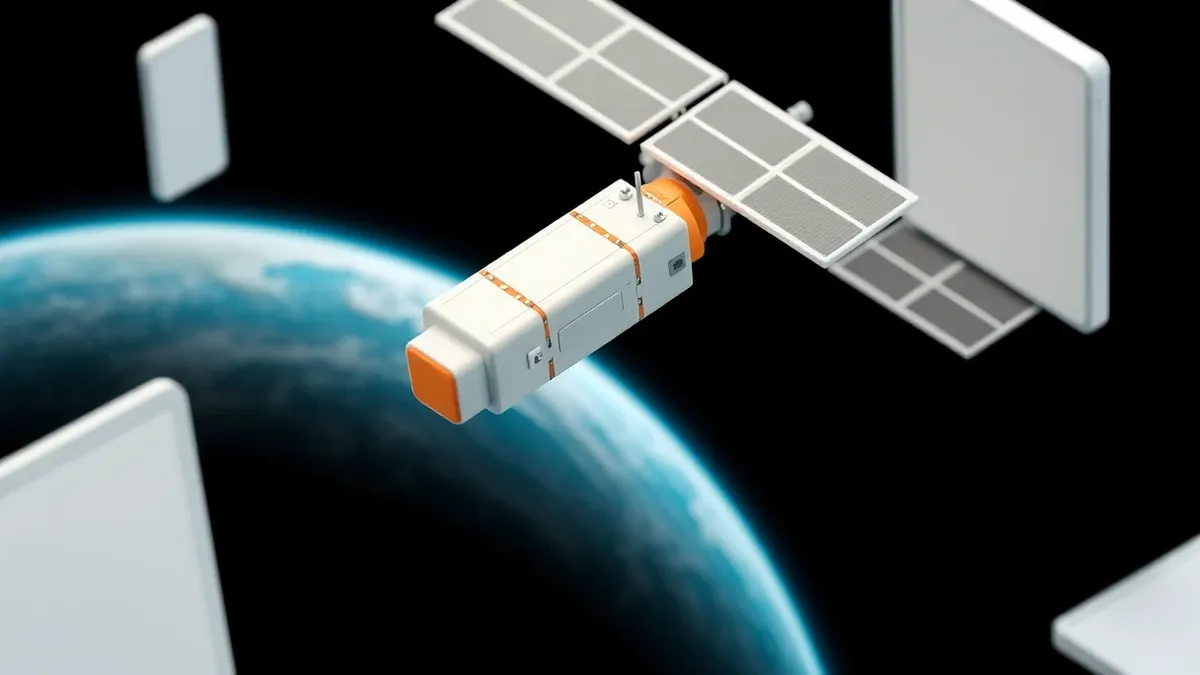
Google’s Suncatcher prototype satellite is online and communicating with ground stations after launching earlier this month on a SpaceX Falcon 9 rocket, according to TechCrunch AI.reported The spacecraft carries a single Google Tensor Processing Unit (TPU) and generates up to 1 kW of electricity.reported This mission aims to pave the way for future networks of close-flying satellites performing large inference workloads in orbit.
Evidence: reported
Google’s first data center satellite is online and writing poetryaifleet-techcrunch
Evidence: reported
Google’s first data center satellite is online and writing poetryaifleet-techcrunch
What was released or claimed
Google stated that the satellite is operating nominally. Engineers sent their first prompt this week to the pre-loaded Google DeepMind Gemma 4 model.reported They asked the model to write a haiku about being in space. The model returned a three-line poem about the Earth and starlight. Google also tested the model with space-themed limericks and asked the spacecraft to report on orbital conditions around the satellite.
Evidence: reported
Google’s first data center satellite is online and writing poetryaifleet-techcrunch
Who it affects
The test campaign directly involves Google engineers and researchers. It targets the development of future satellite networks for inference workloads. The results will inform hardware design for processors operating in space environments.
What is still unknown
It remains unclear how long-term exposure to space radiation will affect TPU reliability. The power demands of the TPU limit operation to about twenty minutes at a time. This constraint complicates space-to-ground communications, which are already tricky. Ground tests suggested radiation impact would be minimal for inference, but real-world dynamics are still being assessed.
So what
If the onboard TPU proves capable, Google plans to launch two more satellites equipped with advanced chips in 2027.reported Those future spacecraft will support higher power generation and demonstrate inter-satellite optical links. This step could enable distributed AI processing in low Earth orbit.
Evidence: reported
Google’s first data center satellite is online and writing poetryaifleet-techcrunch
What the paper shows
This report details an engineering validation test, not a peer-reviewed paper. It tests whether a single TPU can run Gemma 4 inference in orbit.reported The reported result is nominal operation after commissioning.reported The stated limitation is the 20-minute duty cycle due to power constraints. The research gap is the actual impact of space radiation on bit flips and data corruption, which ground simulations could not fully replicate.
Evidence: reported
Google’s first data center satellite is online and writing poetryaifleet-techcrunch
Why it matters
- Researchers can assess how orbital radiation affects TPU inference accuracy versus training stability.
- The 20-minute duty cycle highlights power constraints for high-performance AI chips in space.
- Successful tests may enable distributed inference networks, reducing latency for orbital data processing.
- Real-world bit flip data will inform error-correction strategies for future space-based AI hardware.
Topics: Google, TPU, Gemma 4, space computing, AI inference
Updated
Ask the article
Local keyword search of this article; no generated answers.Did this article give you the evidence you needed?
Your choice stays on this device. No public tally.Questions readers ask
Which AI model is running on the Google satellite?
The satellite runs Google DeepMind’s Gemma 4 model, which was pre-loaded onto the spacecraft.
How much power does the satellite generate?
The satellite generates up to 1 kW of electricity, limiting TPU operation to about twenty minutes at a time.
What is the next step for this project?
If the current TPU proves capable, Google plans to launch two more satellites with advanced chips in 2027.
Connected stories
Reading receipt
- The satellite carries one TPU and runs Google DeepMind’s Gemma 4 model.
- Ground tests showed nominal operation after a three-week commissioning phase.
- Radiation effects on hardware will be assessed in real orbital conditions.